
The New Reality of Hiring in 2025
Picture this: You’re a recruiter screening applications for a software developer role. Your AI-powered system has just reviewed 200 resumes in minutes and presented you with the top 10 candidates.
But here’s what you don’t know, nearly half of those resumes weren’t actually written by the candidates. They were created by AI.
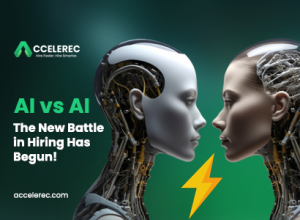
Welcome to the AI resume arms race, where artificial intelligence is now on both sides of the hiring process. And it’s changing everything about how we recruit.
The Numbers Tell the Story
Let’s look at what’s actually happening right now:
On the Candidate Side:
- 49% of job seekers have used AI to write their resumes
- 31% of resume builder users created their CV with AI in 2024
- 92% of AI-generated resumes still require manual edits
- 66% of job applicants are ready to use AI for resume writing
On the Employer Side:
- 83% of companies will use AI to screen resumes by 2025
- 82% of companies currently use AI to review applications
- 74% of hiring managers have encountered AI-generated content in applications
- 99% of Fortune 500 companies use some form of automated screening
The result? We’ve got AI screening AI-written resumes. It’s an arms race nobody expected.
How Did We Get Here?
The Candidate Perspective
Job seekers started using AI for a simple reason, it saves massive amounts of time.
Writing a tailored resume for every job application used to take hours. With ChatGPT and similar tools, candidates can create a custom CV in minutes. They simply:
- Feed the AI their work history
- Add the job description
- Ask it to write a resume optimised for that specific role
- Make a few edits
- Submit
For someone applying to 10 or 20 jobs, AI can save weeks of work.
The Employer Challenge
Meanwhile, companies face the opposite problem, too many applications.
Here’s the reality:
- The average job posting receives 250 applications
- Recruiters spend 23 hours per week just screening resumes
- 60% of applications are abandoned because the process takes too long
That’s why 83% of companies now use AI to handle the initial screening. It’s not about being lazy, it’s about survival when you’re drowning in CVs.
The Problem: AI vs AI Creates New Issues
When both sides use AI, strange things start happening.
Issue #1: Keyword Stuffing Works Too Well
AI-written resumes are optimised for AI screening. They’re packed with exactly the right keywords, in exactly the right format.
But here’s the catch—88% of employers believe their AI systems screen out highly qualified candidates because of formatting issues or missing keywords.
So we end up with:
- Great candidates with “bad” resumes getting rejected
- Average candidates with “perfect” AI resumes getting through
The AI arms race rewards those who game the system, not necessarily those with the best skills.
Issue #2: Bias Gets Amplified on Both Sides
University of Washington research found that AI screening systems favour white-associated names 85% of the time. They favour female-associated names only 11% of the time. And they never favoured Black male-associated names over white male-associated names.
But it gets worse, when candidates use AI to write resumes, those biases can get baked in on that side too. The AI might unconsciously copy patterns from successful resumes, which often reflect existing biases.
Issue #3: Nobody Knows Who’s Real Anymore
74% of hiring managers have seen AI-generated content in applications. But here’s the question, what about the other 26%? Did they really not see any, or did they just not notice?
Some candidates are even using:
- AI to create fake portfolio projects (35% of hiring managers have seen this)
- Deepfake technology in video interviews (17% have encountered this)
- Fake AI-generated LinkedIn profiles (43% of Gen Z hiring managers have spotted these)
When you can’t trust what’s real anymore, how do you hire?
What This Means for Recruiters
The Bad News
Traditional resume screening is becoming almost useless. Here’s why:
AI-written resumes are designed to beat your screening. They know exactly what keywords to include, how to format for ATS systems, and how to present experience in the most impressive way, even if it’s a bit exaggerated.
Your AI might be missing great candidates. Research shows that 88% of employers believe ATS systems screen out highly qualified people. You might be rejecting your best applicants because their real, human-written resume doesn’t tick all the AI boxes.
You can’t tell who’s authentic. Unless you’re one of the 74% of hiring managers who’ve learned to spot AI-generated content, you might not even realise you’re reading AI-written applications.
The Good News
This isn’t unsolvable. You just need to adapt your approach.
How Modern Recruitment Software Handles the AI Arms Race
The best recruitment platforms in 2025 aren’t trying to out-AI the candidates’ AI. Instead, they’re getting smarter about the entire process.
Solution #1: Focus on Skills, Not Keywords
Platforms like Accelerec are moving beyond simple keyword matching. Instead of just scanning for words like “Python” or “project management,” modern AI looks at:
- Actual achievements and results
- How skills are applied in context
- Patterns that indicate real experience vs keyword stuffing
This makes it much harder for AI-written resumes to game the system with clever keyword placement.
Solution #2: Speed Up the Entire Process
Here’s a truth bomb—candidates use AI because they’re applying to dozens of jobs. But if your hiring process was faster, they wouldn’t need to spam applications.
Modern recruitment software like Accelerec helps by:
- Screening applications in seconds instead of days
- Automatically scheduling interviews
- Keeping candidates informed at every stage
- Reducing time-to-hire by 60%
When candidates get quick responses and clear communication, they’re more likely to put genuine effort into their application.
Solution #3: Look Beyond the Resume
The smartest recruiters in 2025 are realising that resumes, whether AI-written or not, only tell part of the story.
Modern hiring platforms offer:
Pre-assessment tests that can’t be easily faked by AI. Someone might use ChatGPT to write their resume, but they still need to actually demonstrate their skills.
AI interviews for initial screening that ask follow-up questions based on responses. This quickly reveals whether someone actually has the experience they claim.
Skills-based evaluation that focuses on what people can do, not just what their CV says they’ve done.
Solution #4: Accept AI, But Verify
Here’s the reality—90% of hiring managers say it’s acceptable to use AI in application materials. The cat’s out of the bag. AI resume writing isn’t going away.
The solution isn’t to fight it. It’s to adjust your process.
Smart recruitment software now helps by:
- Flagging potentially AI-generated content for extra scrutiny
- Automatically following up with specific questions about experience
- Testing actual skills rather than trusting resume claims
- Moving quickly to interviews where you meet the real person
What You Can Do Right Now
If You’re a Recruiter
Assume many resumes are AI-assisted. Don’t rely solely on resume screening. Use it as a first filter, but follow up quickly with assessments that test real skills.
Speed up your process. The longer your hiring takes, the more applications you’ll get from people using AI to spam jobs. Quick responses attract serious candidates.
Use modern screening tools. Platforms like Accelerec use AI that’s designed to handle AI-written resumes. They look deeper than keywords and formatting.
Test actual skills. Move beyond the resume quickly. Use pre-assessments, practical tests, or trial projects to see what people can really do.
Keep humans in the loop. 85% of companies that use AI still have humans make final decisions. Never let AI reject candidates without human oversight.
The Bottom Line
The AI resume arms race isn’t going away. Both candidates and employers have legitimate reasons to use AI in the hiring process.
The question isn’t whether to use AI—it’s how to use it wisely.
For recruiters: Stop trying to catch people using AI to write resumes. Instead, build a hiring process that tests real skills and moves quickly enough that candidates don’t need to spam applications.
For software providers: Focus on tools that look deeper than keywords, speed up the entire process, and keep bias out of both AI-written applications and AI-powered screening.
For the industry: We need to move beyond the resume-centric hiring model. Skills matter more than credentials. Potential matters more than perfect keyword optimisation.
The AI resume arms race is here. The companies that win won’t be those with the best AI, they’ll be those who use AI to focus on what truly matters: finding great people who can do great work.
Ready to navigate the AI hiring revolution? Accelerec helps you screen smarter, hire faster, and build better teams, even when AI is writing half the resumes you receive.